Tumors in cats
A lump on your cat: possible causes and how it's investigated
A lump on a cat may be an abscess, a reaction to an injection or a tumour. Why lumps in cats shouldn't be left for later, which signs are urgent and how the diagnosis is made.
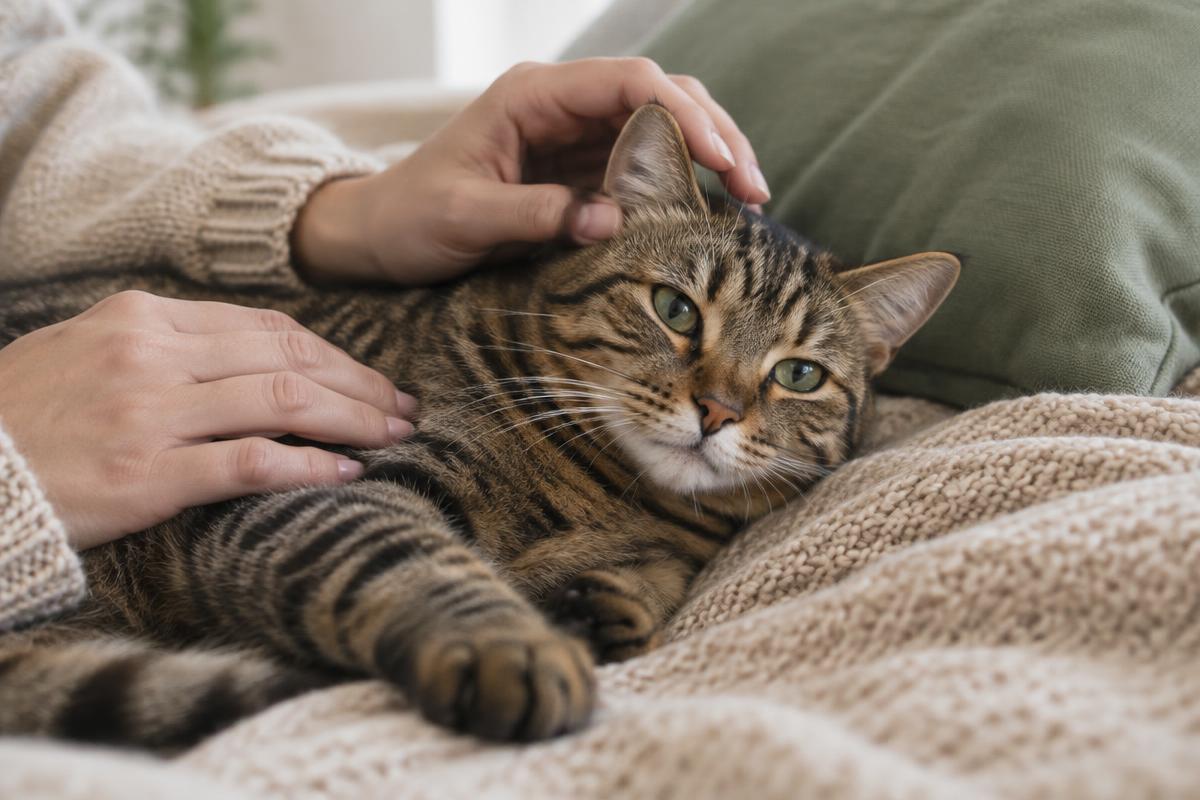
A lump on a cat can be anything from a bite abscess to a tumour. Two things set cats apart: a larger share of lumps in cats are malignant than in dogs, and cats are very good at hiding illness. So any new lump on your cat deserves a vet visit within a week or two — and a lump near the nipples, in the mouth or one that grows quickly should be seen as soon as possible. You can't tell what a lump is by touch; that needs a look at its cells or tissue.
The short answer
- Not every lump is a tumour, but "watching it for months" is a poor strategy in cats.
- A lump along the mammary chain needs prompt attention.
- A lump at an injection site that doesn't go away should be checked.
- The usual first test is a fine-needle aspirate (cytology).
Possible causes of lumps in cats
- Abscess — common in cats that go outdoors: pus collects under the skin after a bite. Usually painful and warm; the cat may be quiet or feverish.
- Injection reaction — a small inflammatory swelling after a vaccine or injection that typically shrinks over a few weeks.
- Cysts and benign skin tumours, such as basal cell tumours.
- Skin mast cell tumours — often a small firm nodule in cats; their behaviour varies, so an accurate diagnosis matters.
- Mammary tumours — in cats, most are malignant, so any nodule along the nipple line should be investigated without delay.
- Injection-site sarcoma — rare but aggressive; it can develop where an injection was given months or years earlier.
- Enlarged lymph nodes — due to infection, inflammation or lymphoma.
- Changes on the ears, nose and eyelids of pale-coloured cats — scabs or sores that don't heal can be squamous cell carcinoma.
The 3-2-1 rule for lumps after an injection
Feline vaccination guidance offers a simple rule: an injection-site lump should be investigated — usually with a biopsy — if it:
- is still present 3 months after the injection;
- is larger than 2 cm across;
- is still growing 1 month after the injection.
If any one of these applies, don't wait. These lumps need careful surgical planning, so they shouldn't be removed quickly without a diagnosis.
When to see a vet urgently
- The lump is growing fast, bleeding or ulcerated.
- The lump is in the mammary area.
- There is swelling or a mass in the mouth, trouble eating, drooling or bad breath.
- Your cat is breathing with effort or with its mouth open.
- Your cat hasn't eaten for more than a day, is hiding or lethargic — in cats, going without food is dangerous in itself.
How the lump is investigated
Your vet will examine your cat from nose to tail, measure the lump and feel the lymph nodes. The usual next step is a fine-needle aspirate: a needle collects cells for cytology. It's quick and generally doesn't need anaesthesia, although some cats are calmer with light sedation. Cytology is good at identifying abscesses, inflammation, cysts and a number of tumours. If it's inconclusive, a biopsy with histopathology follows — see Cytology or biopsy.
To assess general health, cats often have blood and urine tests plus testing for feline leukaemia virus (FeLV) and feline immunodeficiency virus (FIV) — part of the minimum database recommended in oncology guidelines. If a malignant tumour is suspected, staging follows: chest X-rays or CT, abdominal ultrasound and a check of the lymph nodes. Read more in How cancer is staged in pets.
What to bring to the appointment
- When you first noticed the lump, and a photo next to a ruler.
- Dates and sites of recent vaccinations and injections.
- Information on outdoor access, fights, and changes in appetite or weight.
- Any previous test results.
Questions to ask your vet
- What are the most likely causes, and how can we tell them apart?
- Is cytology enough to start with, or is a biopsy better?
- Are blood tests and viral tests needed?
- If surgery is planned, which tests should come first?
- When and how should we reassess the lump?
Frequently asked questions
Can an abscess heal on its own?
Sometimes an abscess bursts by itself, but untreated infection can spread. A tumour can also look like an abscess, so a vet exam is worthwhile either way.
Does spaying affect the risk of mammary tumours?
Studies show that spaying early lowers the risk of mammary tumours in cats. Discuss timing with your vet.
Should I avoid vaccines because of sarcoma risk?
Injection-site sarcoma is rare, and protection from infectious disease matters. Ask your vet which vaccines your cat really needs and how often.
Important
This article is for general information and does not replace an in-person veterinary examination. Please don't use it to diagnose or treat your cat yourself. An online consultation can help you make sense of results you already have, but it cannot replace an exam or sampling.
Sources and further reading
- AAHA: 2026 Oncology Guidelines for Dogs and Cats (opens in a new tab)
- AAHA Section 3: Tumor Diagnostics and Staging (opens in a new tab)
- ACVS: Mammary Tumors (opens in a new tab) — American College of Veterinary Surgeons.
- Cornell Feline Health Center: Lymphoma (opens in a new tab)
- Veterinary Cancer Society: Pet Owner Resources (opens in a new tab)
Updated 20 October 2026
Related articles
Tumors in cats
Lymphoma in cats: what owners should know
Main forms, diagnostics and questions worth asking your vet.
5 min read

Treatment & follow-up
A tumor has returned after surgery in your dog or cat — what should you do?
A new lump near a surgical scar does not always mean the tumor has returned, but it needs checking. Learn about possible causes, surgical margins, and the tests that help guide further treatment.
9 min read
Symptoms & diagnostics
Mammary Tumors in Dogs and Cats: Signs, Diagnosis and Treatment
A lump near a nipple cannot be assessed by touch alone. Learn how mammary tumors differ in dogs and cats, which tests may be needed, and how surgery and follow-up care are planned.
8 min read